Physical Address
304 North Cardinal St.
Dorchester Center, MA 02124
Physical Address
304 North Cardinal St.
Dorchester Center, MA 02124

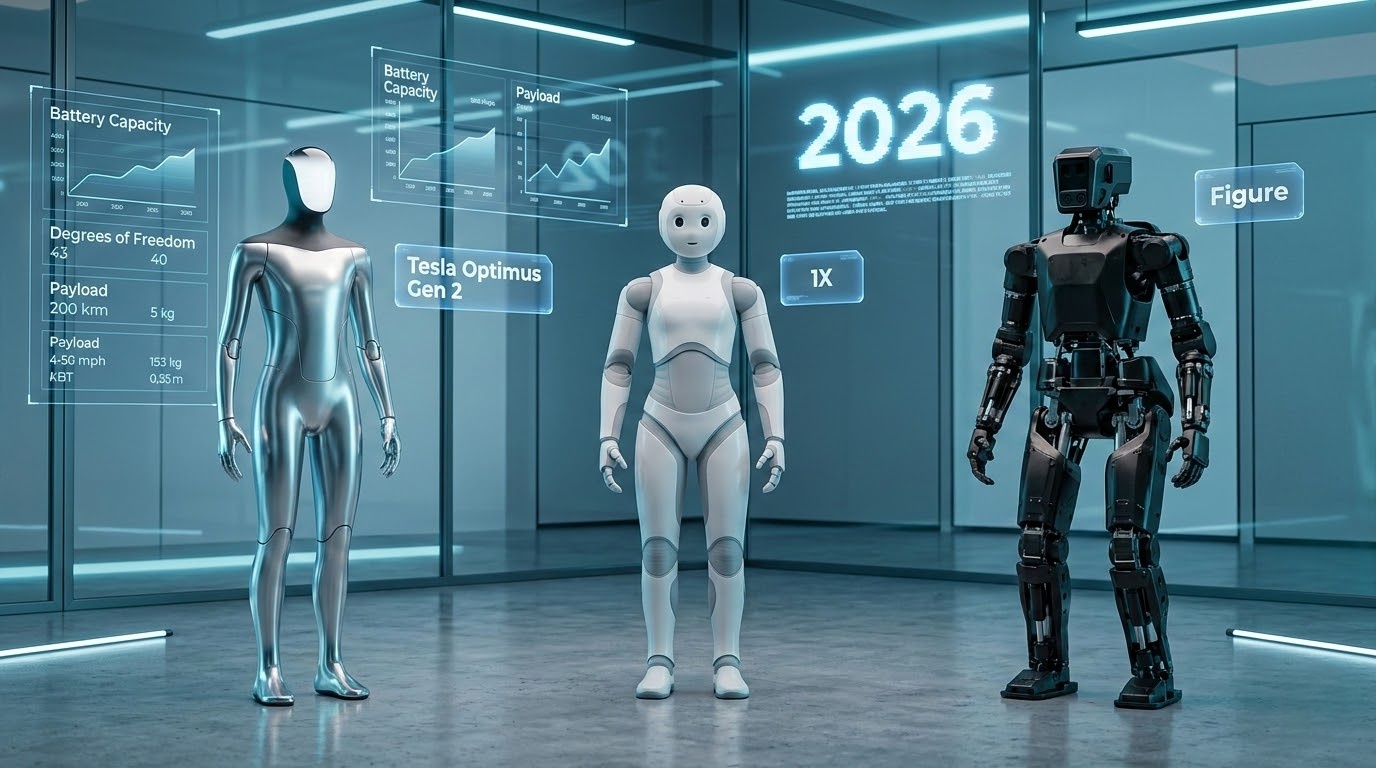
The breakthroughs at CES 2026 signaled a paradigm shift: humanoid robots have officially moved from rigid factory floors to mastering Tesla Optimus home tasks like folding laundry and loading dishwashers. But with the humanoid robot price 2026 landscape stabilizing, the question is no longer if you can buy one, but which domestic humanoid robots fit your life.
Most robots were designed for the rigid lines of car plants, but the race is now on for the best robot for housework. We are moving toward General Purpose AI (GPAI)—machines that don’t just follow code but understand intent through OpenAI robotics and End-to-end neural networks.
The competition between 1X NEO vs Tesla Optimus is the industry’s “Mac vs PC” moment. Here is how the top models stack up in 2026:
| Feature | Tesla Optimus (Gen 3) | 1X NEO | Figure 02 |
| Humanoid robot price 2026 | ~$30,000 | ~$20,000 | ~$130,000 (Enterprise) |
| Degrees of freedom (DoF) | 22 (Hands) | 22 (Hands) | 16 (Hands) |
| Tactile Sensing | Integrated Force | Bio-inspired Tendons | High-resolution Tactile |
| Primary Brain | Tesla FSD / Grok | OpenAI / 1X Vision | Helix VLA (Vision-Language) |
While Figure 02 specs favor industrial precision, the 1X NEO uses soft-shell materials for home safety. Tesla relies on its massive manufacturing scale to keep costs near the price of a mid-size car.
Tesla has undergone a massive internal pivot. As of February 2026, the company officially began converting significant portions of its Fremont factory—previously dedicated to the Model S and Model X—into a dedicated “Optimus Megaline.” This facility is now designed to scale toward a staggering production capacity of one million robots per year.
The most critical update for the Tesla Optimus Gen 3 lies in its “human-plus” dexterity. While previous iterations struggled with stiff movements, the Gen 3 hands now feature 22 degrees of freedom (DoF) in the fingers and an additional 3 DoF in the wrist and forearm.
This mechanical complexity is managed by end-to-end neural networks trained on millions of hours of human video data. This lets the robot do gentle Tesla Optimus house chores that machines could never do before:
Tesla wins because it builds everything itself. It uses the same “Bot Brain” and camera AI found in its cars, which keeps costs very low. By 2027, the price for an Optimus robot should be between $20,000 and $30,000——is about a small car’s price.
| Metric | Tesla Optimus Gen 3 Specification |
| Target Price | $20,000 – $30,000 |
| Hand Dexterity | 22 Degrees of Freedom (DoF) |
| AI Foundation | FSD-derived Vision (No LiDAR) |
| Battery Life | ~8 Hours (2.3 kWh pack) |
| Walking Speed | 8 km/h (approx. 5 mph) |
Even with the buzz, 2026 is still a “test” year for Tesla. The robot is ready to be built in large numbers, but the software is still being fixed in Tesla’s own plants. Right now, thousands of Optimus robots work inside the Fremont and Giga Texas factories. They handle simple, boring jobs like moving parts or putting things together.
For the average consumer, this means that while you can see them “working” via livestream, the waitlist for a true domestic humanoid robot in your own living room likely extends into 2027 for non-beta testers.
If you are part of the early developer program, you can use the following Python snippet to test a basic “Object Recognition & Grip” sequence in the Tesla Virtual Environment (TVE):
Python
import tesla_optimus_sdk as bot

# Initialize the Gen 3 Hand Controller
hand = bot.HandController(side="right")

# Set Tactile Sensitivity for delicate objects (Scale 1-10)
hand.set_tactile_threshold(2) # 2 = Delicate (e.g., Egg or Peach)# Execute 'Poach Egg' sub-routinetry:
    hand.perform_task("pick_and_crack", target="egg_white_large")
    print("Task Success: Minimal shell fragmentation detected.")
except bot.GripError:
print("Warning: Pressure exceeded 5 Newtons. Reducing torque.")While Tesla and Figure are often associated with the high-torque, rigid world of industrial automation, 1X Technologies has taken a radically different approach with NEO. Backed by OpenAI robotics research, NEO is currently the frontrunner for “home-readiness.” Unlike competitors still stuck in the pilot phase, 1X has already begun shipping units to early-access homes across the United States in early 2026.
NEO stands out because of its unique tendon system. Typical robots use hard gears and heavy motors. These can be dangerous if they bump into someone. Instead, NEO has a special “Tendon Drive.” It moves just like real human muscles do.
This design makes the robot “compliant.” If it bumps into a pet or a child, its arms or legs will bend instead of pushing with hard force. With its soft foam skin and a washable suit, it feels more like high-tech gym gear than a heavy machine.
Because 1X is a key partner of OpenAI, NEO features a native integration of the latest multimodal models. This moves the robot beyond simple pre-programmed routines into the realm of true General Purpose AI (GPAI).
You don’t need to write code for NEO. You just talk to it. It uses smart cameras and memory to learn your home. If you tell it, “NEO, find my keys and put them on the table,” it uses its brain to:
NEO is built for agility and safety rather than raw industrial power. Its lightweight frame makes it the most energy-efficient model currently on the market.
| Feature | 1X NEO Specification |
| Height / Weight | 165 cm (5’5″) / 30 kg (66 lbs) |
| Price Point | $20,000 (with $200 refundable deposit) |
| Actuation | Low-inertia Tendon Drives |
| Hand Dexterity | 22 Degrees of Freedom (DoF) |
| AI Integration | OpenAI Multimodal (Audio/Visual/Logic) |
| Safety Rating | HIC < 250 (Human Safe) |
| Battery Life | 4 Hours (6-minute quick charge per hour) |
The humanoid robot price 2026 for a NEO unit is a flat $20,000. To lower the barrier to entry, 1X also offers a $499/month subscription model, which includes hardware insurance and “Expert Mode” assistance.
“Expert Mode” is a hybrid teleoperation feature where a remote 1X operator can “hop into” the robot’s eyes to help it finish a complex task it hasn’t learned yet, like fixing a specific brand of coffee machine.
If you have received your Early Access unit, you can manage its schedule via the mobile app. Here is an example of how the “Chore Syntax” works for recurring tasks:
JSON
{
  "chore_name": "Morning Tidy",
  "trigger": "08:30 AM",
  "actions": [
    {"task": "navigate", "location": "kitchen"},
    {"task": "load_dishwasher", "mode": "delicate"},
    {"task": "wipe_surfaces", "tool": "microfiber_cloth"},
    {"task": "return_to_dock", "reason": "charge_ready"}
  ],
  "safety_level": "standard_household"
}
1X chose a light, soft design to avoid the many rules that slow down heavy metal robots. For busy homes with kids or seniors, NEO is likely the top choice for household help this year.
If Tesla is the mass-market sedan and 1X is the friendly roommate, Figure 02 is the heavy-duty luxury SUV of the humanoid world. After making headlines for its rigorous 11-month deployment at the BMW Spartanburg plant—where it successfully handled over 90,000 sheet-metal parts with a 99% accuracy rate—Figure AI has begun pivoting its second-generation hardware toward a “home-industrial” hybrid model.
While many home robots only handle light chores, Figure 02 is made for the “heavy lifting” of a busy house. It can easily handle up to 45 lbs or 20 kg due to its strong electric motors and powerful joints. So, it is the best choice for:
The “brain” of Figure 02 is its most impressive asset. It features a Triple-GPU onboard processing unit (utilizing dual NVIDIA RTX modules), providing 3x the inference power of its predecessor. This massive compute overhead allows the robot to run its Helix VLA (Vision-Language-Action) model locally, enabling split-second decision-making.
Combined with tactile sensing that can detect forces as small as three grams, Figure 02 can pick up a heavy toolbox and a fragile wine glass with equal proficiency. Unlike robots that rely on cloud processing—leading to “lag” during commands—Figure 02 responds to natural language via OpenAI robotics integrations almost instantly.
The following table highlights why Figure 02 is considered the premium choice for users who prioritize raw performance.
| Specification | Figure 02 Detail | Comparison Note |
| Height / Weight | 168 cm / 70 kg | More stable than the lightweight 1X NEO |
| Payload Capacity | 20 kg (44 lbs) | Highest in its class for home-industrial use |
| Hands | 16 Degrees of Freedom (DoF) | Optimized for tool use and firm grips |
| Processing | Triple-GPU (NVIDIA RTX) | 3x faster inference than Figure 01 |
| Battery Life | ~5 Hours | Optimized for intensive tasks |
| Target Price | $30,000 – $50,000 | Luxury tier / High-end consumer |
Quality comes at a cost. With a humanoid robot price 2026 estimated between $30,000 and $50,000, Figure 02 remains out of reach for many households. It is currently positioned as a luxury-tier option for early adopters who require a robot capable of more than just “social” interaction.
Furthermore, while it excels at General Purpose AI (GPAI) tasks, its 70 kg frame is significantly heavier than its competitors. This necessitates a more careful “home mapping” phase to ensure it navigates around delicate furniture safely.
For owners with the Figure 02 Developer Suite, you can manually override the tactile sensing parameters for custom household objects. Use the following YAML-style configuration to set a “Soft-Touch” zone:
YAML
# Figure 02 Custom Task Profile: Antique Vase Handlingtask_profile:name: "delicate_transfer"sensors:tactile_sensitivity: highforce_limit_newtons: 3.5vision:object_tracking: "enabled"depth_buffer: 0.05maction:speed_multiplier: 0.4grip_type: "spherical_precision"While Figure 03 has already been announced as the official successor for mass-market home safety, Figure 02 remains the “productivity powerhouse” for those who need real work done today.
Choosing a robot in 2026 requires balancing raw power against safety and price. The following table summarizes the key metrics for the top three consumer-facing models.
| Feature | Tesla Optimus (Gen 3) | 1X NEO | Figure 02 |
| Height | 173 cm (5’8″) | 165 cm (5’5″) | 168 cm (5’6″) |
| Weight | 57 kg (125 lbs) | 30 kg (66 lbs) | 70 kg (154 lbs) |
| Hand Dexterity (DoF) | 22 Degrees of Freedom | 22 Degrees of Freedom | 16 Degrees of Freedom |
| Target Price | $25,000 – $30,000 | $20,000 | $30,000 – $50,000+ |
| Best Home Feature | Ecosystem (Tesla App/FSD) | Safety (Soft Body) | Productivity (Heavy Lifting) |
| Availability | Factory Deployment (Pilot) | Shipping to Early Adopters | Commercial Pilot (BMW) |
As home robots start moving into our personal spaces, people are worried about two main things. These are physical safety and the security of our private data.
How 1X NEO and Tesla Optimus are built shows their biggest differences.
Humanoids require “always-on” vision to function as a General Purpose AI (GPAI). Manufacturers have taken different approaches to handle this sensitivity:
The humanoid robot price 2026 market is finally tiered for different lifestyles.
As we enter 2026, the market will have three main price groups.
The best models differ mostly in terms of safety. The 1X NEO is designed with a “soft-body” philosophy, utilizing a tendon-based system and compliant actuators that give way upon contact, making it the safest option for high-traffic homes. Tesla Optimus and Figure 02 stick to standard stiff frames. They make up for this with fast touch sensors and 360-degree cameras. These robots rely on neural networks to avoid hitting things in real time. If something moves nearby, they will usually stop or slow down instantly to stay safe.
Privacy is managed through a combination of local processing and data masking. Leading models in 2026, such as 1X NEO, feature “Privacy Zones” where the robot can be programmed to automatically blur its camera feed or stop recording when entering sensitive areas like bathrooms or bedrooms. Tesla utilizes end-to-end encryption similar to its vehicle fleet, where the majority of visual data is processed locally on the robot’s “brain” rather than the cloud. Most manufacturers now also include physical “kill-switches” and “Offline Modes” that allow the robot to perform basic housework tasks without a persistent internet connection.